
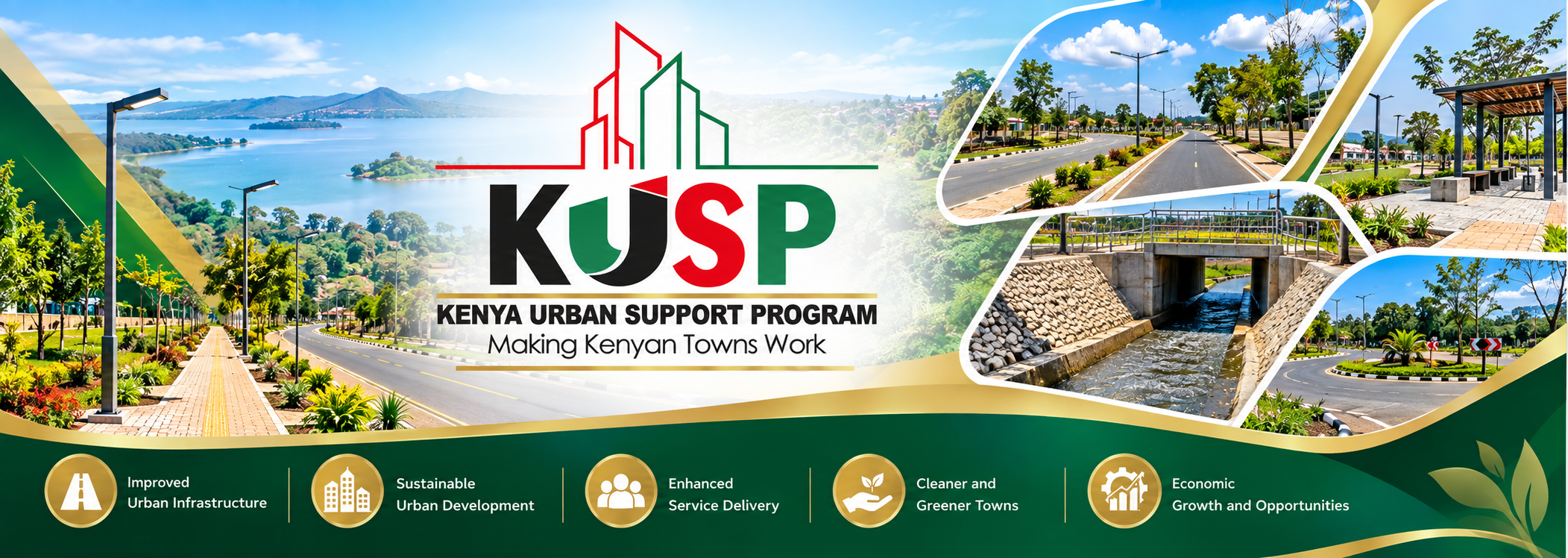
Overview
The Kenya Urban Support Programme (KUSP) is a Government of Kenya urban-development programme supported by the World Bank and implemented through the State Department for Housing and Urban Development in collaboration with county governments and municipalities. Its purpose is to strengthen urban governance, improve municipal institutions, finance urban infrastructure and improve the quality, resilience and inclusiveness of services in Kenya’s growing towns. Housing and Urban Development
For Siaya County, KUSP has been particularly important in supporting the development of Siaya Municipality and establishing stronger systems for municipal planning, infrastructure investment, public participation and service delivery.
Under the first phase, KUSP I, Siaya Municipality was among the municipalities supported nationally. The programme helped establish and strengthen municipal governance structures while providing resources for infrastructure and institutional development.
Siaya County’s FY2024/25 budget documentation records several achievements associated with KUSP I. These include the construction of Non-Motorized Transport facilities and drainage works within Siaya Town in Phases 1, 2 and 3, explicitly identified by the county as KUSP I-funded projects. Other municipal improvements reported alongside these investments include high-mast lighting at Siaya Jua Kali and Modern Market, refuse chambers at Mbaga, Boro and Siaya Modern Markets, parking bays, street naming and strengthening of the municipal secretariat. Siaya County Assembly
The programme therefore goes beyond physical construction. It has helped Siaya develop the institutional framework required to operate a municipality, including municipal boards, technical staff, planning systems, financial management, citizen engagement and development planning.
The Kenya Urban Support Programme Phase II (KUSP II) builds on KUSP I but places stronger emphasis on sustainable and climate-resilient urban development, institutional capacity, inclusive infrastructure, planning and resilience, private-sector engagement and improved municipal service delivery. KUSPII
Nationally, the current KUSP II framework identifies 59 municipalities across 45 counties as participating municipalities. The official KUSP II programme listing includes Siaya Municipality in Siaya County. KUSPII
The programme uses performance-linked financing arrangements, principally Urban Development Grants (UDG) for infrastructure and Urban Institutional Grants (UIG) for institutional strengthening, planning, governance and municipal service-delivery capacity. Municipalities are assessed against programme requirements before accessing applicable financing. KUSPII
KUSP II Intervention
For Siaya, the programme can be understood through several interconnected areas:
| Area | Focus in Siaya |
|---|---|
| Urban Governance | Strengthening the Municipal Board, municipal administration, accountability and institutional arrangements |
| Urban Planning | Municipal spatial planning, development control and integration of infrastructure with long-term land-use planning |
| Roads & Mobility | Urban roads, pedestrian facilities and non-motorized transport |
| Stormwater Drainage | Drainage infrastructure and reduction of urban flooding |
| Street Lighting | Improved safety, mobility and economic activity |
| Markets & Economic Infrastructure | Supporting infrastructure serving businesses, traders and local economic activity |
| Solid Waste Management | Improved collection, handling and disposal systems |
| Climate Resilience | Incorporating climate and disaster risks into infrastructure planning |
| Citizen Participation | Citizen fora, stakeholder consultations and public participation |
| Grievance Redress | Mechanisms for residents to lodge complaints and receive responses |
| Institutional Capacity | Staffing, organizational structures, HR systems, training and operational procedures |
| Private-Sector Engagement | Improving municipal engagement with businesses and potential investors |
These areas correspond closely with the national KUSP II result areas and with Siaya Municipality’s documented mandate and development priorities. KUSPII
KUSP II Infrastructure Investment
A significant current KUSP II intervention is the proposed development of Non-Motorized Transport facilities, stormwater drainage and street lighting along Biashara Street, specifically the street running along the Bus Park and Modern Market in Siaya Town.
The County Government’s September 2026 tender notice confirms that the project is being undertaken using financing received by the Government of Kenya from the World Bank under KUSP II. Siaya County
This investment combines three important urban functions: pedestrian mobility, drainage and lighting. In practical terms, such an integrated corridor can improve pedestrian safety and accessibility around the bus park and market, manage stormwater, improve the usability of the commercial area and support safer movement after dark.
Non-Motorized Transport and Urban Mobility
Non-Motorized Transport, or NMT, has already been an important component of KUSP implementation in Siaya.
Under KUSP I, Siaya Municipality reports construction of NMT and drainage infrastructure through Phases 1, 2 and 3. Siaya County Assembly
KUSP II continues this direction through investments such as the Biashara Street project. The approach recognizes that urban mobility involves more than motor vehicles. Pedestrians, persons with disabilities, traders, public-transport users and other road users require safe and accessible infrastructure.
Stormwater Management and Climate Resilience
Stormwater management is particularly relevant to sustainable urban development because road construction without adequate drainage can transfer flooding problems to surrounding properties.
Siaya Municipality’s spatial planning documents identify flooding among the municipality’s disaster risks and recommend measures including mapping risk-prone areas, expanding roads to accommodate stormwater drainage and applying engineering solutions to flooding. Siaya County Assembly
KUSP II’s broader climate-resilience approach therefore complements Siaya’s municipal spatial-planning priorities.
Institutional Strengthening
KUSP II is also supporting the institutional development of Siaya Municipality.
In June 2025, the County Government reported an engagement involving Grant Thornton Advisory East Africa Limited, Siaya County officials and municipal stakeholders under KUSP II. The assignment involved gathering information on municipal operations, staffing and technical requirements to support the development of model organizational structures and standardized human-resource policies and procedures for urban institutions. Siaya County
This institutional component is important because infrastructure requires an organization capable of planning, operating and maintaining it.
Institutional strengthening can therefore cover areas such as municipal staffing structures, technical competencies, planning procedures, financial management, procurement, asset management, revenue administration, performance management, public participation and reporting.
Municipal Spatial Planning
Urban investment under KUSP should also be understood alongside the Siaya Municipality Spatial Plan.
The County Government has undertaken preparation and stakeholder validation of municipal spatial-planning documents, while the county publication repository contains the Siaya Municipality spatial plan and related planning documents. Siaya County
The spatial plan provides a framework for determining where development should occur and how transport networks, commercial areas, settlements, public facilities, environmental areas and infrastructure should interact.
This is important for KUSP because infrastructure investment should support the municipality’s longer-term spatial development rather than operate as isolated construction projects.
Citizen Participation
Citizen engagement forms an important part of municipal governance in Siaya.
The County Government publishes records of Siaya Municipality Citizen Fora, including reports covering different quarters and consultations relating to Annual Development Plans. Siaya County
Citizen fora provide residents, businesses, community organizations and other stakeholders with opportunities to identify priorities, discuss municipal performance and provide input into proposed programmes and investments.
For KUSP-related projects, this also helps ensure infrastructure priorities reflect local needs.
Grievance Redress Mechanism
Siaya Municipality also maintains a Grievance Redress Mechanism (GRM).
The county’s online system provides a municipal complaint request mechanism through which residents can identify the concerned municipality, categorize a complaint, describe the issue and provide supporting documentation. Siaya County
A functioning GRM is particularly relevant to infrastructure projects because concerns may arise around construction impacts, accessibility, environmental issues, contractors, drainage, land, businesses or public safety.
Financing Framework
KUSP II uses two major financing mechanisms.
Urban Development Grants (UDG) primarily finance eligible municipal infrastructure. These may include roads, drainage, NMT facilities, markets, bus parks, street lighting, waste-management facilities and related urban infrastructure.
Urban Institutional Grants (UIG) support institutional capacity, planning, governance and improvements in municipal service delivery. KUSPII